
 Welcome to the Small Engine Repair and Garden Tractor Pulling
Tips and Tricks Websites!
Welcome to the Small Engine Repair and Garden Tractor Pulling
Tips and Tricks Websites!
Welcome to the Small Engine Repair and Garden Tractor Pulling
Tips and Tricks Websites!
Welcome to the Small Engine Repair and Garden Tractor Pulling
Tips and Tricks Websites!
These are the Essential Websites That Every Small Engine Repair Enthusiast
and Competitive Garden Tractor Puller Need! Educating and Inspiring Small
Engine, Lawn & Garden, and Garden Pulling Tractor Enthusiasts Since 1996.
Where Science and Common Sense Come Together for Safety and Improved
Engine/Tractor Performance |
A-1
Miller's Performance Enterprises - Parts & Services
Webstore |  Check it out: Overstocked Kohler Engine Parts & Cub Cadet
Garden Tractor Parts | For Sale:
Detailed Illustrated Plans on How to Construct Professional Pulling Sleds
| Professionally Built, Fully Functional and Nice-Appearing Tractor Pulling
Sleds (Weight Transfer Machines)
Check it out: Overstocked Kohler Engine Parts & Cub Cadet
Garden Tractor Parts | For Sale:
Detailed Illustrated Plans on How to Construct Professional Pulling Sleds
| Professionally Built, Fully Functional and Nice-Appearing Tractor Pulling
Sleds (Weight Transfer Machines)
No registration or password required, no automatic popups, no spyware,
adware, viruses, Trojan Horses or malicious codes inside. If you have any
problems with any of my web sites, please inform A-1
Miller's and I will correct it/them immediately! All of my web sites
are easy to navigate, too...no tricky links or shenanigans! Also, all my
web sites are educational, easy to understand, safe and enjoyable to read
for all ages! The information in my web sites is more understandable and
direct than any Kohler or Cub Cadet publication. And it's best to use the
newest version of
Google
Chrome or
Microsoft's
Internet Explorer web browsers to experience all the effects of my web
sites. Optimized for 1024 x 768 screen resolution. To search for a word or
phrase in any of my web sites, press CTRL and F simultaneously to open the
Find dialog box in your web browser. Nowadays, prices are subject to change
without notice. Click
Refresh to see any
changes or updates. Optimized for 1152 x 864 computer screen resolution.
To search for a word or phrase in any of my websites, press the CTRL
 and F
and F  keys on
your keyboard simultaneously to open the Find or Search dialog box in your
web browser. And being I have no
apprentice to update and pay for my websites so they'll
continue to be on the Internet, they will be removed forever when I'm no
longer around.
keys on
your keyboard simultaneously to open the Find or Search dialog box in your
web browser. And being I have no
apprentice to update and pay for my websites so they'll
continue to be on the Internet, they will be removed forever when I'm no
longer around.
Liability Disclaimer and Privacy Statement:
The linked websites below are a publication of A-1 Miller's Performance
Enterprises. Every attempt is made to ensure the information is accurate
and up-to-date. However, as the design of certain products or parts change,
I make no warranty or guarantee regarding the accuracy of information in
my sites. I am not responsible for the content or accuracy in any of my websites,
the sites that are linked to or referenced from any of my sites; nor do I
necessarily endorse the websites linked to or referenced from any of my sites.
Use these Tips and Tricks at your own risk. You are responsible for what
you do to your engine and/or tractor with the information provided in my
web sites. It's like what the preacher says: "Don't do as I do, do as I say.
But then again, don't always do as I say. Just use your own best judgment."
Another important thing to remember - If you think that a flywheel, clutch
or steering part might fail when pulling, then by all means, either repair
or replace it. Never take chances! Because an innocent bystander could get
seriously injured or even killed if a questionable part is overlooked. Which
in turn would take all the fun out of the sport of pulling. And always make
use of proper shielding where necessary, and wheelie bars, even if your club
doesn't require them. And if anyone feels uncomfortable using these tips
in constructing or modifying a competitive pulling tractor, then please consult
with a professional tractor/engine builder for assistance. Users requesting
accuracy confirmation and FREE professional technical questions may contact
A-1 Miller's via e-mail address noted at the bottom of any of my web pages.
Remember - as long as there's German ingenuity, all hope is not lost. Also,
if some of my tips and tricks don't help you do well in pulling, install
a hood ornament as a good luck charm.

Introduction to the Sport of Competition Garden Tractor Pulling -
What is Tractor Pulling?
Tractor pulling competition is when a special-built weighted pulling vehicle or tractor pulls (or drags) a mechanical weight transfer machine, which is more commonly known as a "sled" or "weight transfer machine" on a dirt (clay) track of a specific distance, which is usually a maximum of 300 feet in length. As the vehicle pulls the sled down the track, ballast (weights) that's in a box which is positioned at the rear of the sled is automatically transferred (mechanically winched) forward on the frame of the sled. This transfer of weight, or ever-increasing of weight, creates friction between the skid pan (that's part of the front of the sled) and the ground, and that in turn makes the sled harder to pull, eventually stopping the vehicle. The winner is determined by not how fast a pulling vehicle goes down the track, but who drags the sled the farthest. In other words, it's not a race, it's a pulling event. Go here for more information: Tractor pulling - Wikipedia, the free encyclopedia. Pulling is like any other motorsport, or any other sport as far as sports are concerned. It's something you will never make money at. It's about the competition, making new friends and making lasting memories.
Tractor pulling is popular because it offers a high-adrenaline spectacle of raw power, combining intense, loud, and smoky competition with a strong sense of community and family-friendly entertainment . Fans love the "man and machine" battle, where heavily modified tractors aim to drag a weighted sled the farthest down a 300-foot track.
Key Reasons for Its Popularity:
The sport, known as "Pull on Sunday, Plow (or Mow) on Monday," has evolved from its agricultural or lawn and garden roots to include highly modified, expensive machines that can pull an incredibly heavy load.
Tractor pullers from various areas are like one big family, not bound together by blood relation, but by a common interest. Many of them are hard working, honest people that have a job and family to support. A garden tractor puller with a good reputation of being honest can be a lot of fun for the entire family and/or with friends, and very affordable. Competition garden tractor competition pulling also helps to bring families and friends closer together. It helps build a strong relationship between parents and their kids, and it's a great way to spend quality family time together. A broken tractor is much easier to fix than a broken family. Besides, if you don't spend the time, energy (and money) with your family and kids now, then perhaps one day you'll wish you did. Remember this old saying: "A family that prays together, stays together"? Well, a family that pulls together, also stays together." Theodor Seuss Geisel (Dr. Seuss) said: "Sometimes you will never know the value of a moment until it becomes a memory."
 The sport of pulling can be
a fun and exciting family activity. Competition garden tractor pulling can
be a fun and safe sport for the entire family. If done fairly, garden tractor
pulling helps build good character and sportsmanship in people of all ages.
Sports has always been considered a healthy outlet for young people. A chance
for young people to learn how to win or rather lose. But most importantly,
how to play by the rules, which help keep them out of trouble at home and
with the law. Kids also need proper parental guidance so they can live a
happier, healthier and more fulfilling adulthood. This is a good sport for
people of all ages (as long as they can safely operate a tractor). Sons,
daughters, nieces, nephews and any other kid who has gotten bored and are
running the streets too much. If you have the means to spend some money to
help kids go down the right path and have good clean fun, then competition
garden tractor pulling is for you and your family. Kids can also develop
skills to learn how to build a winning engine and tractor, and pass their
knowledge down to their kids. Not only the young can enjoy competition garden
tractor pulling, but older folks can enjoy it, too. It gives retired people
a good excuse to get out of the house, and keep their mind and body active.
The sport of pulling can be
a fun and exciting family activity. Competition garden tractor pulling can
be a fun and safe sport for the entire family. If done fairly, garden tractor
pulling helps build good character and sportsmanship in people of all ages.
Sports has always been considered a healthy outlet for young people. A chance
for young people to learn how to win or rather lose. But most importantly,
how to play by the rules, which help keep them out of trouble at home and
with the law. Kids also need proper parental guidance so they can live a
happier, healthier and more fulfilling adulthood. This is a good sport for
people of all ages (as long as they can safely operate a tractor). Sons,
daughters, nieces, nephews and any other kid who has gotten bored and are
running the streets too much. If you have the means to spend some money to
help kids go down the right path and have good clean fun, then competition
garden tractor pulling is for you and your family. Kids can also develop
skills to learn how to build a winning engine and tractor, and pass their
knowledge down to their kids. Not only the young can enjoy competition garden
tractor pulling, but older folks can enjoy it, too. It gives retired people
a good excuse to get out of the house, and keep their mind and body active.
During the summer months when school is out, concerned parents of most kids in upper class families will always find something [productive] for them to spend their time or help them further their education for a future career. But some kids in low- to middle-class families get bored with not much to do, and not much guidance in life. Some kids end up in trouble and can get a record that will haunt them for the rest of their life. However, to help prevent this from possibly happening, [the city council of] some small towns approve, promote and assist in encouraging certain local motor sports, such as garden tractor pulling, go-kart racing, motorcycle racing, etc., but only if a local and caring landowner is willing to donate and/or provide their land for this type of use. With the help of the kid's parents, and other concerned adults, these type of motorsports will help keep the kids' minds occupied, help them develop useful mechanical skills, work well with others, show good sportsmanship, courtesy to others, get higher grades in school, and become a better member of society. And when the kids grow into adults, maybe they'll want to move up into the bigger truck and/or tractor pulling, race cars, etc. And these adults might want to help their kids get into the smaller motorsports to keep their minds occupied as well. It'll be better that they spend their money on projects like these than alcohol and drugs.


 When involved
in garden tractor pulling, or virtually any other motorsport, with a reliable
vehicle and trailer, you and your family and kids, and/or your friends and
their kids get a chance to travel to other small towns or communities, see
the beautiful countryside and interesting roadside attractions along the
way while on the road, meet interesting people, have a chance to be with
other pullers who share your interests and make new friends, you can dine
at nice restaurants, perhaps even stay at a motel before or after a pull!
Traveling to and from a pull should be half the fun! As they say, it's not
just about the destination - it's about the journey. While at a pull site,
if it's at a county fair, there's usually other activities also. Early before
the pull begins or when the pull is over (if it's not too late), you and
your family can walk around the fairgrounds to see the sites, and your kids
can go on the carnival rides. The rides are usually free, because most of
the time there's free admission [for pullers and helpers] to the fair! And
please remember, ALWAYS drive carefully, get plenty of rest before starting
a long trip so the driver will be alert for unexpected events while on the
road, and definitely wear your seat belts! Remember - Life is precious, help
support others and enjoy it while you can!
When involved
in garden tractor pulling, or virtually any other motorsport, with a reliable
vehicle and trailer, you and your family and kids, and/or your friends and
their kids get a chance to travel to other small towns or communities, see
the beautiful countryside and interesting roadside attractions along the
way while on the road, meet interesting people, have a chance to be with
other pullers who share your interests and make new friends, you can dine
at nice restaurants, perhaps even stay at a motel before or after a pull!
Traveling to and from a pull should be half the fun! As they say, it's not
just about the destination - it's about the journey. While at a pull site,
if it's at a county fair, there's usually other activities also. Early before
the pull begins or when the pull is over (if it's not too late), you and
your family can walk around the fairgrounds to see the sites, and your kids
can go on the carnival rides. The rides are usually free, because most of
the time there's free admission [for pullers and helpers] to the fair! And
please remember, ALWAYS drive carefully, get plenty of rest before starting
a long trip so the driver will be alert for unexpected events while on the
road, and definitely wear your seat belts! Remember - Life is precious, help
support others and enjoy it while you can!
 Also, just a reliable average
size pickup truck or SUV and a small- to medium-size
utility trailer is all that's needed to haul the garden
tractor(s) to and from the pulls. And remember - cracks in a trailer frame
and broken leaf springs are caused by the tires being out of balance. A lot
of people don't bother having trailer tires balanced because they think it's
not important. The very first thing to do before going on a long road trip
is to inspect and inflate ALL the tires, on the tow vehicle, trailer and
the spare tires!
Also, just a reliable average
size pickup truck or SUV and a small- to medium-size
utility trailer is all that's needed to haul the garden
tractor(s) to and from the pulls. And remember - cracks in a trailer frame
and broken leaf springs are caused by the tires being out of balance. A lot
of people don't bother having trailer tires balanced because they think it's
not important. The very first thing to do before going on a long road trip
is to inspect and inflate ALL the tires, on the tow vehicle, trailer and
the spare tires!
 Utility Trailers Need Regular
Maintenance, too! I watched a YouTube video of a tractor puller who paid
more attention and performed more maintenance to his pulling tractor than
to the trailer he uses to haul it on to and from the pulls. In one of his
videos, one day, far from home on the way to a pull, a wheel bearing on his
trailer went out, which also damaged the tire on the same hub. Luckily, he
had a good spare tire, but he had a heck of a time getting the burnt-out
and damaged wheel bearing fixed. Tsk, tsk on him.
Utility Trailers Need Regular
Maintenance, too! I watched a YouTube video of a tractor puller who paid
more attention and performed more maintenance to his pulling tractor than
to the trailer he uses to haul it on to and from the pulls. In one of his
videos, one day, far from home on the way to a pull, a wheel bearing on his
trailer went out, which also damaged the tire on the same hub. Luckily, he
had a good spare tire, but he had a heck of a time getting the burnt-out
and damaged wheel bearing fixed. Tsk, tsk on him.
 Competition garden tractor pulling
is a sport, just like any other sport. Some people like to go fishing. Some
play golf at a country club. Others prefer to do truck and tractor pulling.
All these activities are considered sports, which is supposed to be fun and
relaxing. If a tractor performs well at a pull, and if there's prize money
to be won, most of the time the prize money isn't that much. In fact, the
winner would be lucky to make gas money. But it's fun to compete, test your
knowledge and mechanical skills how to build the tractor and use your driving
skills on the track. Competition garden tractor pulling is not only appropriate
for the entire family, but actually makes people feel encouraged, inspired,
and challenged. It's also a good excuse to get your mind off your daily job
and routine life, and it's a good reason to get away from home (and perhaps
work) for a while, like a short vacation. And if you think about it, a sport
that you enjoy doing regularly is in reality mental therapy and a
great stress relief. It's an "escape" from a boring, humdrum or monotonous
way of life to maintain yours and your family's or friend's mental sanity
and stability. In fact, to maintain a great and wonderful society, many
communities should encourage a sport like this for people with an average
income. But there's not much money to be made in competition garden tractor
pulling. Instead, the business leaders of most communities prefer to build
more golf clubs, country clubs and vacation resorts because there's a lot
more money to be made with these venues.
Competition garden tractor pulling
is a sport, just like any other sport. Some people like to go fishing. Some
play golf at a country club. Others prefer to do truck and tractor pulling.
All these activities are considered sports, which is supposed to be fun and
relaxing. If a tractor performs well at a pull, and if there's prize money
to be won, most of the time the prize money isn't that much. In fact, the
winner would be lucky to make gas money. But it's fun to compete, test your
knowledge and mechanical skills how to build the tractor and use your driving
skills on the track. Competition garden tractor pulling is not only appropriate
for the entire family, but actually makes people feel encouraged, inspired,
and challenged. It's also a good excuse to get your mind off your daily job
and routine life, and it's a good reason to get away from home (and perhaps
work) for a while, like a short vacation. And if you think about it, a sport
that you enjoy doing regularly is in reality mental therapy and a
great stress relief. It's an "escape" from a boring, humdrum or monotonous
way of life to maintain yours and your family's or friend's mental sanity
and stability. In fact, to maintain a great and wonderful society, many
communities should encourage a sport like this for people with an average
income. But there's not much money to be made in competition garden tractor
pulling. Instead, the business leaders of most communities prefer to build
more golf clubs, country clubs and vacation resorts because there's a lot
more money to be made with these venues.
The Basic Differences Between a Riding Mower, Lawn Tractor, Lawn & Garden Tractor, Garden Tractor, and Compact Tractor - (Click on the blue underlined links below to Google images.) [Top of Page]
To start out in pulling, an ordinary riding mower or lawn & garden tractor can be used for tractor pulling. People do it all the time. Just remember that the sled will need to be lightweight and the tractors will need a low hitch height (below the centerline of the rear axle) to prevent from breaking the transaxle and they'll need wheelie bars for safety.
A Typical Competitive Garden Pulling Tractor Would Tech Out Much Like This:
 Type of Tractor: Mostly
clutch-drive Cub
Cadet, built by International Harvester or the early clutch-drive MTD
models.
Type of Tractor: Mostly
clutch-drive Cub
Cadet, built by International Harvester or the early clutch-drive MTD
models.
Economical/Low-Budget and Durable Class of Competition
Garden Pulling Tractor:
This particular class of pulling tractor is safe and ideal for young people or for budget-minded people starting out in the sport of pulling. It makes the sport of competition garden tractor pulling fun and very affordable. It doesn't cost much to build one of these tractors and it puts on a fantastic display of exhaust-roaring power and tire-spinning action on the track. Plus, with the low (10") drawbar/hitch height and smaller (23x10.50-12) tires, a low-cost heavy duty clutch assembly can be used, and there's a very little chance of twisting or breaking a stock [coarse spline] axle and/or [lightweight] differential carrier. With the low hitch height and smaller tires, no extra weight will need to be added toward the front of the tractor. This type of tractor would need to be used with a lightweight, easy-to-start (ATV) pulling sled (weight transfer machine). |
 To make pulling competition a fun and fair sport for the
entire family, be protective of your equipment! While at the pulls, keep
an eye on your carburetor, fuel shut-off valve and killswitch plug! When
a competitive or winning pulling tractor is left alone, it's been known that
certain disgruntled pullers
(sore losers
To make pulling competition a fun and fair sport for the
entire family, be protective of your equipment! While at the pulls, keep
an eye on your carburetor, fuel shut-off valve and killswitch plug! When
a competitive or winning pulling tractor is left alone, it's been known that
certain disgruntled pullers
(sore losers  ) belonging
to various clubs/associations, virtually anywhere and everywhere, will turn
the high speed main fuel adjuster one way or the other, close the fuel shut-off
valve or pull the killswitch plug and toss it out of sight to keep the engine
from running at it's full potential, or from running at all. This is one
of the easiest, dishonest and sneaky ways to retard or disable and sabotage
a competitor's tractor. All a cheater needs is an opportunity in an attempt
to gain an advantage over the other pullers. This is also the fastest way
for a pulling organization to gain a bad reputation. (Bad news travels fast.)
This type of behavior doesn't happen often, but you need to be prepared if
or when it does happen. To be prepared for this unforeseeable event, it'll
be a good idea to cover the entire carburetor with a
drawstring bag, or better yet, cover the entire tractor
with a canvas or heavy blanket, and carry an extra killswitch plug with you.
Always try to stay one step ahead of a cheater.
) belonging
to various clubs/associations, virtually anywhere and everywhere, will turn
the high speed main fuel adjuster one way or the other, close the fuel shut-off
valve or pull the killswitch plug and toss it out of sight to keep the engine
from running at it's full potential, or from running at all. This is one
of the easiest, dishonest and sneaky ways to retard or disable and sabotage
a competitor's tractor. All a cheater needs is an opportunity in an attempt
to gain an advantage over the other pullers. This is also the fastest way
for a pulling organization to gain a bad reputation. (Bad news travels fast.)
This type of behavior doesn't happen often, but you need to be prepared if
or when it does happen. To be prepared for this unforeseeable event, it'll
be a good idea to cover the entire carburetor with a
drawstring bag, or better yet, cover the entire tractor
with a canvas or heavy blanket, and carry an extra killswitch plug with you.
Always try to stay one step ahead of a cheater.

 Also, to "cap off" or plug the header pipe to prevent rain
water from entering into it and/or to keep a disgruntled puller from sabotaging
a competitive pulling tractor by jamming a rock down in the pipe (this have
been known to happen), use an adjustable rubber expansion plug, like the
one pictured to the right. Most popular ones are:
Dorman
AutoGrade 02601 (1-1/4"),
Dorman
AutoGrade 02602 (1-3/8"), or
Dorman
AutoGrade 02603 (1-1/2"). These require more effort to remove than the
popular slip-on vinyl sleeve cover, because cheaters like a "quick and easy"
way to sabotage a tractor. Because there's cheaters in every sport,
and nobody likes a cheater, not even cheaters themselves!
Also, to "cap off" or plug the header pipe to prevent rain
water from entering into it and/or to keep a disgruntled puller from sabotaging
a competitive pulling tractor by jamming a rock down in the pipe (this have
been known to happen), use an adjustable rubber expansion plug, like the
one pictured to the right. Most popular ones are:
Dorman
AutoGrade 02601 (1-1/4"),
Dorman
AutoGrade 02602 (1-3/8"), or
Dorman
AutoGrade 02603 (1-1/2"). These require more effort to remove than the
popular slip-on vinyl sleeve cover, because cheaters like a "quick and easy"
way to sabotage a tractor. Because there's cheaters in every sport,
and nobody likes a cheater, not even cheaters themselves!

But then again, if the winning tractor is suspected of cheating on the track (illegal engine, etc.), there's always the protest and/or disqualification rule(s). But only IF the protest rule is enforced! Remember - cheating is devious theft with a sly smirk. Heck, some pulling associations/clubs vote-in and/or change certain rules in a meeting during the off-season, lock them in for several years, but don't even enforce or follow their own rules during the pulling season! They change their rules so often, they might as well just write them in pencil! Another thing I don't understand is when a [prominent] puller of an association/club ask the president of the club if an illegal part can be used in his engine for pulling, and the president says, "yeah, sure!" But the pulling association/club's sanctioning rules, the very same rules that the members (pullers) of the association/club discussed about and voted-on in a meeting, clearly states in black and white that such a part cannot be used.
 Then there's the cheater(s) who think the association/club's
rules don't apply to them, grown men that act like spoiled brats. Like the
pullers who help set up pulls and get lots of money for the person who hauls
the sled to and from the pulls and operate the sled. And it's especially
bad when the sled hauler and operator, who sometimes happens to be the same
person, is the president of the association/club! When the "helpful" cheater
bend or breaks the rules, or the sled operator lowers the small wheels on
the front of a self-propelled sled to allow the cheater to gain an edge over
the other competing tractors, no other puller or the president says anything
or complains to the cheating puller because they are afraid the club will
lose a bunch of quality pulls the following year, or some scheduled pulls
during the pulling season could be canceled by the cheating puller. In other
words, they don't want to bite the hand that feeds them. It's hard for honest
pullers to compete against a corrupted puller who display arrogant and
antagonistic behavior, especially when the people in charge of the association
or club show favoritism for that puller. They do their dirty work in private
and it's all dirty politics, folks. And it's a corrupted and dishonest way
to run a pulling association/club. Wonder how these kind of people can expect
to succeed in life with their attitude? Unless they have no life and feel
that you must judge others because they secretly live an unfulfilling and
pathetic life. If a cheater did whatever it took to cheat, then they can
do whatever it takes to play by the rules. If they can't play fair, then
they shouldn't play at all.
Then there's the cheater(s) who think the association/club's
rules don't apply to them, grown men that act like spoiled brats. Like the
pullers who help set up pulls and get lots of money for the person who hauls
the sled to and from the pulls and operate the sled. And it's especially
bad when the sled hauler and operator, who sometimes happens to be the same
person, is the president of the association/club! When the "helpful" cheater
bend or breaks the rules, or the sled operator lowers the small wheels on
the front of a self-propelled sled to allow the cheater to gain an edge over
the other competing tractors, no other puller or the president says anything
or complains to the cheating puller because they are afraid the club will
lose a bunch of quality pulls the following year, or some scheduled pulls
during the pulling season could be canceled by the cheating puller. In other
words, they don't want to bite the hand that feeds them. It's hard for honest
pullers to compete against a corrupted puller who display arrogant and
antagonistic behavior, especially when the people in charge of the association
or club show favoritism for that puller. They do their dirty work in private
and it's all dirty politics, folks. And it's a corrupted and dishonest way
to run a pulling association/club. Wonder how these kind of people can expect
to succeed in life with their attitude? Unless they have no life and feel
that you must judge others because they secretly live an unfulfilling and
pathetic life. If a cheater did whatever it took to cheat, then they can
do whatever it takes to play by the rules. If they can't play fair, then
they shouldn't play at all.
Association-Owned Pulling Sleds VS Private-Owned Pulling Sleds -
An association-owned pulling sled is when all the pullers/members of a sanctioning pulling association or club owns the sled they use at all of their pulls. It is not owned by just one person. A privately-owned sled is when an individual (one person) or a small group of people (usually family members) owns their own sled.

 The problem with an association-owned or member-owned pulling
sled is a lot of cheating and favoritism by certain pullers can take place
at the pulls. Most spectators and pullers on the sidelines are watching the
tractor itself. Hardly any spectator in the audience pays attention to the
operation of the sled or position of the weight box while the tractor is
dragging it down the track. (As a sled operator and owner, I've seen this
happen so many times at virtually every pull.) If or when a disqualification
is in question when it comes to a cheating puller, being no one person owns
the sled, the only thing the president or board members of the club have
in their favor to back them up and what gives them full authority is the
honor and loyalty of the other [honest] pullers, and the disqualification
is justified. But if the cheating puller has more pulling friends on his
side to back him up, then the president doesn't have much authority, the
disqualification ruling will unlikely to stand. Absolute power corrupts
absolutely. And as far as I know, there are no association's or club's rules
regarding proper sled operation or respectful sled operator behavior. The
sled operator can cheat for certain pullers and no other puller can do anything
about it, except perhaps quit pulling with them.
The problem with an association-owned or member-owned pulling
sled is a lot of cheating and favoritism by certain pullers can take place
at the pulls. Most spectators and pullers on the sidelines are watching the
tractor itself. Hardly any spectator in the audience pays attention to the
operation of the sled or position of the weight box while the tractor is
dragging it down the track. (As a sled operator and owner, I've seen this
happen so many times at virtually every pull.) If or when a disqualification
is in question when it comes to a cheating puller, being no one person owns
the sled, the only thing the president or board members of the club have
in their favor to back them up and what gives them full authority is the
honor and loyalty of the other [honest] pullers, and the disqualification
is justified. But if the cheating puller has more pulling friends on his
side to back him up, then the president doesn't have much authority, the
disqualification ruling will unlikely to stand. Absolute power corrupts
absolutely. And as far as I know, there are no association's or club's rules
regarding proper sled operation or respectful sled operator behavior. The
sled operator can cheat for certain pullers and no other puller can do anything
about it, except perhaps quit pulling with them.
A private-owned sled on the other hand, and if the sled owner is honest, allows him to have full authority concerning a cheating pullers' non-sportsmanship behavior resulting in a disqualification. The owner of the sled has the sled itself to back him up in an argument. "If you won't accept it (details of the disqualification), I won't let you pull my sled!"
YouTube video: Pulling Sled Exposed For Cheating? You Decide.. https://www.youtube.com/watch?v=7Jd5rEuaZZA
Always Wear a Helmet When Pulling!
It's known for a fact that some pullers don't wear a seat belt in their vehicles while traveling to and on their way home from the pulls. (Safety must be the last thing on their mind.) But unlike seat belts, wearing a helmet isn't only for safety, it makes the puller look PROFESSIONAL to the sponsors, promoters and spectators! Tractor pulling is a spectator entertainment sport, or show business. And to put on a good show, you gotta dress for the part!
And if the sanctioning rules require that long leg pants and closed-end shoes be worn when pulling, if a puller wears shorts, and complain about the summer heat, they can just slip on some sweat pants and closed-end shoes, and then go pull. As long as their legs and feet are covered, that's what matters.
And during the hot summer heat, sometimes tempers will flair at a pull site. It's just human nature. This is something track officials and pullers need to take into consideration when confronting a disgruntled puller. When this happens, just tell them to drink some ice water, go cool off, calm down and gather your thoughts. Because they're not being themselves. It'll be wrong to get upset at them. Because when you're an official of an organization, you must delegate authority honestly and responsibly.
Using a Competitive Cub Cadet Pulling Tractor - [Top of Page]

 If you've always enjoyed "turning a wrench"
and wanted to build a mini-rod, pulling truck or farm/modified tractor, but
found that these are too costly, start with a competition garden pulling
tractor, because of their size, it would not require a lot of money, huge
work shop, and large truck and trailer to haul the pulling vehicle to and
from the pull sites. If you're looking for a quality garden tractor to build
up and do some serious pulling with, then what you need is a beltless,
non-hydrostatic drive, clutch-driven,
manual shift Cub Cadet that was built by International Harvester and the
early ones built by MTD (Modern Tool & Die). The best Cub Cadet garden
tractors for competition pulling are clutch driven. These models include:
If you've always enjoyed "turning a wrench"
and wanted to build a mini-rod, pulling truck or farm/modified tractor, but
found that these are too costly, start with a competition garden pulling
tractor, because of their size, it would not require a lot of money, huge
work shop, and large truck and trailer to haul the pulling vehicle to and
from the pull sites. If you're looking for a quality garden tractor to build
up and do some serious pulling with, then what you need is a beltless,
non-hydrostatic drive, clutch-driven,
manual shift Cub Cadet that was built by International Harvester and the
early ones built by MTD (Modern Tool & Die). The best Cub Cadet garden
tractors for competition pulling are clutch driven. These models include:
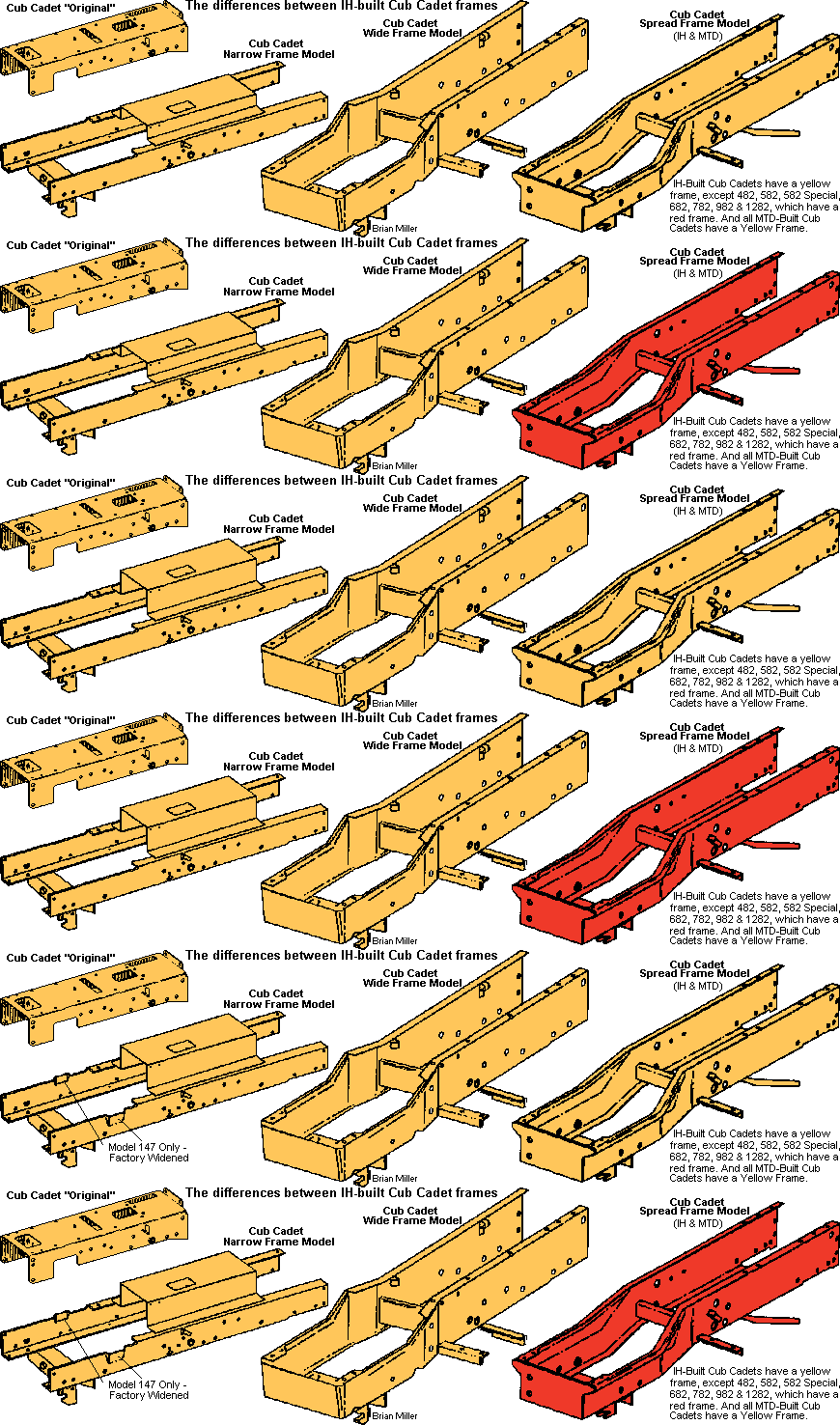
The differences between the IH- and MTD-built Cub Cadet frames:
 On the IH-built Narrow
Frame models 70, 71, 72, 73, 100, 102, 104, 105, 106, 107, 122, 123, 124,
125, 126, 127 and 147, the the entire length of the frame rails are the same
width and height. This frame was designed only for a single cylinder Kohler
engine with a starter/generator and small diameter (8") flywheel. Models
70, 71, 72, 73, 100 and 102 have a short center cover on the frame, while
the other models have a tall center cover. The tall center cover is to make
clearance for the cooling fan on the driveshaft of hydrostatic drive models
105, 107, 123, 125, 127 and 147. The frame rails on model 147 was widened
at the factory to accommodate the large 9-1/2" diameter flywheel and flywheel
shroud, but were never installed.
On the IH-built Narrow
Frame models 70, 71, 72, 73, 100, 102, 104, 105, 106, 107, 122, 123, 124,
125, 126, 127 and 147, the the entire length of the frame rails are the same
width and height. This frame was designed only for a single cylinder Kohler
engine with a starter/generator and small diameter (8") flywheel. Models
70, 71, 72, 73, 100 and 102 have a short center cover on the frame, while
the other models have a tall center cover. The tall center cover is to make
clearance for the cooling fan on the driveshaft of hydrostatic drive models
105, 107, 123, 125, 127 and 147. The frame rails on model 147 was widened
at the factory to accommodate the large 9-1/2" diameter flywheel and flywheel
shroud, but were never installed.
 When building and/or acquiring
a pulling tractor, it's best to use what the winners are using - a direct
drive with a mechanical clutch disc (no belt- or hydrostatic-drive involved)
Cub Cadet and use the biggest engine your club's/association's rules allow
in its tractor's class. The best Cub Cadet garden tractors to use for serious
competition pulling are models: 70, 71, 72, 73, 86, 100, 102, 104, 106, 108,
122, 124, 126, 128, 580, 582, 800, 1000, 1050, 1200, 1282 (clutch drive model),
1512, 1535, 1606 and 1806. Avoid using models
When building and/or acquiring
a pulling tractor, it's best to use what the winners are using - a direct
drive with a mechanical clutch disc (no belt- or hydrostatic-drive involved)
Cub Cadet and use the biggest engine your club's/association's rules allow
in its tractor's class. The best Cub Cadet garden tractors to use for serious
competition pulling are models: 70, 71, 72, 73, 86, 100, 102, 104, 106, 108,
122, 124, 126, 128, 580, 582, 800, 1000, 1050, 1200, 1282 (clutch drive model),
1512, 1535, 1606 and 1806. Avoid using models
 with a right angle gearbox and
Peerless transaxle. These don't pull as well in the higher horsepower classes.
Anyway, there's sanctioning rules with every pulling organization regarding
how a tractor should be built or set up. Not all clubs/associations use the
same sanctioning rules and specifications. The rules vary from one organization
to another. You'll need to contact the person in charge of the organization
you plan to pull with and acquire a copy of their up-to-date rules and ask
their pullers questions before you build a tractor. And while you're at the
pulls, look over the pulling tractors and ask the pullers questions regarding
how to build a durable and competitive tractor. And remember - if you're
going to build it, might as well build it to win! Because 2nd place is the
first loser.
with a right angle gearbox and
Peerless transaxle. These don't pull as well in the higher horsepower classes.
Anyway, there's sanctioning rules with every pulling organization regarding
how a tractor should be built or set up. Not all clubs/associations use the
same sanctioning rules and specifications. The rules vary from one organization
to another. You'll need to contact the person in charge of the organization
you plan to pull with and acquire a copy of their up-to-date rules and ask
their pullers questions before you build a tractor. And while you're at the
pulls, look over the pulling tractors and ask the pullers questions regarding
how to build a durable and competitive tractor. And remember - if you're
going to build it, might as well build it to win! Because 2nd place is the
first loser.
 If you don't want to embarrass
yourself in front of the spectators, then don't waste your time, money and
materials on something less than a true-to-it's-name garden tractor. Stamped
steel frame lawn tractors (MTD, Murray, etc.) simply cannot compete against
the power and torque or muscle of a true garden tractor. If you want to win
or at least do well at the pulls and look good doing it, then get yourself
a clutch-drive Cub Cadet, and use the stamped steel frame lawn tractors to
mow your lawn with. Or adapt the lawn tractor sheet metal (hood, grill, fenders,
steering support column, etc.) onto a Cub Cadet frame.
If you don't want to embarrass
yourself in front of the spectators, then don't waste your time, money and
materials on something less than a true-to-it's-name garden tractor. Stamped
steel frame lawn tractors (MTD, Murray, etc.) simply cannot compete against
the power and torque or muscle of a true garden tractor. If you want to win
or at least do well at the pulls and look good doing it, then get yourself
a clutch-drive Cub Cadet, and use the stamped steel frame lawn tractors to
mow your lawn with. Or adapt the lawn tractor sheet metal (hood, grill, fenders,
steering support column, etc.) onto a Cub Cadet frame.
 To be competitive in garden tractor
pulling, what you need is a garden tractor that has an automotive-type frame,
horizontal engine, a cast iron transaxle and 12" diameter, 5-lug rear wheels.
It can be belt drive, too. Look for a good-size Wheel Horse or a Sears Suburban.
They're the most popular and least expensive to build up for pulling in a
stock class. Fact is, the drive belt on some garden tractors robs the engine
of power. The Cub Cadet on the other hand use a direct drive clutch/driveshaft
system, which is much like the ones that's used in automobiles. You get more
power to the track with a Cub Cadet. belt-drive garden tractors, such as
Wheel Horse, Sears Suburban, etc., do very well in the stock classes with
a limited horsepower engine, but if you want to move up into a more powerful
or highly modified class, the Cub Cadet is the only way to go. They've been
proven to be the most competitive garden tractor for pulling that's available.
Remember - Tractor pulling is a science, and sometimes making the right changes
to a pulling tractor can get confusing. The best thing to do is just follow
your gut instinct or conscience (the very first thought that enters your
mind) and your tractor should be more competitive. Don't listen to second
thoughts. They can cause problems.
To be competitive in garden tractor
pulling, what you need is a garden tractor that has an automotive-type frame,
horizontal engine, a cast iron transaxle and 12" diameter, 5-lug rear wheels.
It can be belt drive, too. Look for a good-size Wheel Horse or a Sears Suburban.
They're the most popular and least expensive to build up for pulling in a
stock class. Fact is, the drive belt on some garden tractors robs the engine
of power. The Cub Cadet on the other hand use a direct drive clutch/driveshaft
system, which is much like the ones that's used in automobiles. You get more
power to the track with a Cub Cadet. belt-drive garden tractors, such as
Wheel Horse, Sears Suburban, etc., do very well in the stock classes with
a limited horsepower engine, but if you want to move up into a more powerful
or highly modified class, the Cub Cadet is the only way to go. They've been
proven to be the most competitive garden tractor for pulling that's available.
Remember - Tractor pulling is a science, and sometimes making the right changes
to a pulling tractor can get confusing. The best thing to do is just follow
your gut instinct or conscience (the very first thought that enters your
mind) and your tractor should be more competitive. Don't listen to second
thoughts. They can cause problems.
And the reason there's different classes for pulling tractors is because some tractors come with a bigger engine and some weigh more than others. A tractor with a big engine will undoubtedly out-pull a tractor with a small engine. And the same goes for a tractor that weighs more than the others. Therefore, most pulling clubs/associations try to match the engine size and the weight of any particular tractor (with the driver) so they'll be competitive within their class.
Ever noticed how there's always more Cub Cadets at the pulls than any other make of garden tractor? That's because the Cub Cadet is capable of transferring more usable horsepower and torque to the rear tires through a unique direct-drive disc clutch system much like the ones used in automobiles, farm tractors, etc. And, there's more high-performance parts readily available for the IH Cub Cadet and Kohler engine than any other make of garden tractor or engine.
 One of the most popular bodies
to adapt onto an IH Cub Cadet frame is from certain models of John Deere
garden tractors. The reason for this is many pullers like the John Deere
so well, but sometimes they can't out-pull a Cub Cadet. So they create a
"generic" John Deere garden tractor. That's when the John Deere body parts
are integrated onto a Cub Cadet frame. The Cub Cadet frames that's suitable
for the John Deere body parts are: 102, 104, 105, 106, 107, 122, 123, 124,
125, 126, 127, 147 (narrow frames; because these models have the tall center
section), and any wide or spread frame model. If the JD body parts are installed
correctly and the entire tractor is painted the traditional JD green and
yellow, the tractor will have the appearance of a genuine John Deere, but
the pulling components and power of a Cub Cadet. Many pullers do this. Like
the old saying goes: "If you can't beat 'em, join 'em!"
And if you've noticed how well certain
pulling tractors perform at the pulls, the pullers or engine builders probably
followed the advice in my pulling tips and trick websites.
One of the most popular bodies
to adapt onto an IH Cub Cadet frame is from certain models of John Deere
garden tractors. The reason for this is many pullers like the John Deere
so well, but sometimes they can't out-pull a Cub Cadet. So they create a
"generic" John Deere garden tractor. That's when the John Deere body parts
are integrated onto a Cub Cadet frame. The Cub Cadet frames that's suitable
for the John Deere body parts are: 102, 104, 105, 106, 107, 122, 123, 124,
125, 126, 127, 147 (narrow frames; because these models have the tall center
section), and any wide or spread frame model. If the JD body parts are installed
correctly and the entire tractor is painted the traditional JD green and
yellow, the tractor will have the appearance of a genuine John Deere, but
the pulling components and power of a Cub Cadet. Many pullers do this. Like
the old saying goes: "If you can't beat 'em, join 'em!"
And if you've noticed how well certain
pulling tractors perform at the pulls, the pullers or engine builders probably
followed the advice in my pulling tips and trick websites.
 Ever noticed at the pulls, how
many genuine Cub Cadets show up, but very few John Deeres (or is it pronounced
"John Deere"? hmmm) are there? With a generic John Deere doing well at the
pulls, this puts the Deere name out front. Hence, "Nothing runs like a Deere!"
But nothing pulls like a Cub Cadet!
Ever noticed at the pulls, how
many genuine Cub Cadets show up, but very few John Deeres (or is it pronounced
"John Deere"? hmmm) are there? With a generic John Deere doing well at the
pulls, this puts the Deere name out front. Hence, "Nothing runs like a Deere!"
But nothing pulls like a Cub Cadet!
One thing about the Cub Cadet is, they're so versatile and adaptable for competition pulling! It's easy to adapt wheelie bars, an adjustable pulling hitch, and many other things to these tractors without having to make any major modifications to the frame.
Of course, the body components of other makes and models of popular garden tractors, such as Wheel Horse, etc., can be integrated onto a Cub Cadet frame as well. It just takes some time and effort to figure out how to adapt the parts so it'll look original.
 Most rules require "a garden tractor
frame." Therefore, most pullers prefer to use the later model "wide" and
"spread" Cub Cadet frames. They're strongest frames for use with a high
horsepower engine. They're more rigid and flex less than the older narrow
frames. Frame flex absorbs horsepower and torque, which must be transferred
to the ground through the rear tires. The "wide" frame were originally
manufactured to make room for the small gear starter and large flywheel on
the K241-K341 single cylinder Kohler engine. And the "spread" frame were
originally manufactured for a twin cylinder engine, but a single cylinder
Kohler engine can be easily installed with no adjustments.
Most rules require "a garden tractor
frame." Therefore, most pullers prefer to use the later model "wide" and
"spread" Cub Cadet frames. They're strongest frames for use with a high
horsepower engine. They're more rigid and flex less than the older narrow
frames. Frame flex absorbs horsepower and torque, which must be transferred
to the ground through the rear tires. The "wide" frame were originally
manufactured to make room for the small gear starter and large flywheel on
the K241-K341 single cylinder Kohler engine. And the "spread" frame were
originally manufactured for a twin cylinder engine, but a single cylinder
Kohler engine can be easily installed with no adjustments.
The manufacturer didn't exactly design the Cub Cadet (or virtually any garden tractor) to be fitted with a powerful engine, being weighted down, using 26-12.00x12 cut tread tires and pulling several thousand pounds of stubborn weight with. Therefore, it's necessary to "beef up" the engine, drivetrain, transaxle and frame to be truly competitive and to keep parts from breaking. If you're wanting to win, you might as well build it to win!
 Personally, I think it's
best to convert a Cub Cadet (or any garden tractor) that's dilapidated or
near to being a "piece of junk" into a pulling tractor. Because it'll be
a shame to convert a nice looking, fully functional and useful mowing/utility
tractor into strictly a pulling tractor. Besides, for it to be truly competitive,
the entire tractor, including the engine, drivetrain, transaxle and frame,
will all need to be completely disassembled, reinforced and rebuilt/built-up
from the ground up or from scratch. So why not do it with something that
will need to be totally rebuilt anyway? Because if it's not rebuilt/built-up
now or before the pull(s), you may be wishing it was. And don't be surprised
or disappointed when (not if) changes will need to be made to the tractor
so it'll be more competitive. This is part of the learning process, using
the latest technology, being competitive and enjoying the sport.
Personally, I think it's
best to convert a Cub Cadet (or any garden tractor) that's dilapidated or
near to being a "piece of junk" into a pulling tractor. Because it'll be
a shame to convert a nice looking, fully functional and useful mowing/utility
tractor into strictly a pulling tractor. Besides, for it to be truly competitive,
the entire tractor, including the engine, drivetrain, transaxle and frame,
will all need to be completely disassembled, reinforced and rebuilt/built-up
from the ground up or from scratch. So why not do it with something that
will need to be totally rebuilt anyway? Because if it's not rebuilt/built-up
now or before the pull(s), you may be wishing it was. And don't be surprised
or disappointed when (not if) changes will need to be made to the tractor
so it'll be more competitive. This is part of the learning process, using
the latest technology, being competitive and enjoying the sport.
Using a "backyard sled" (weight transfer machine) to test the competitiveness
of a pulling tractor will not prove if it will out-pull other competing tractors
at the scheduled pulling events. It'll be like a race car on the track by
itself with no competition. The only things a test sled will show is how
well the engine runs, how well the drive clutch grips, how well the weight
of the tractor is "balanced" and how well the driveline and transaxle parts
hold up without breaking. By the way - I think that Cub Cadet garden tractors
make the best pulling tractor. But know what out-pulls a Cub Cadet? Another
Cub Cadet! Of course, other makes and models of garden tractors are competitive,
too.
Construct a Sturdy Platform Table to Build, Service, Maintain or Repair Small Engine Equipment, Riding Mowers, Lawn & Garden Tractors, Competition Garden Pulling Tractors, Go-Karts, ATV's, etc. - [Top of Page]
 I have NEVER repaired any lawn
and garden equipment or pulling tractor directly on the floor in my shop.
Personally, I have a sturdy platform table in our shop that's 24" tall x
42" wide x 72" in length to repair small engine equipment, garden tillers,
riding mowers, lawn & garden tractors, competition garden pulling tractors,
go-karts, ATV's, etc. I also built two other 30" x 42" work tables that stands
waist-high to repair push- and walk-behind lawn mowers, rebuild small engines,
etc. I installed bed-rail angle iron around the perimeter of these tables
so lawn mowers won't roll off and other things won't fall off the edge of
the table and get damaged or lost.
I have NEVER repaired any lawn
and garden equipment or pulling tractor directly on the floor in my shop.
Personally, I have a sturdy platform table in our shop that's 24" tall x
42" wide x 72" in length to repair small engine equipment, garden tillers,
riding mowers, lawn & garden tractors, competition garden pulling tractors,
go-karts, ATV's, etc. I also built two other 30" x 42" work tables that stands
waist-high to repair push- and walk-behind lawn mowers, rebuild small engines,
etc. I installed bed-rail angle iron around the perimeter of these tables
so lawn mowers won't roll off and other things won't fall off the edge of
the table and get damaged or lost.
We've (the Miller family) visited many small engine repair shops and businesses
around Missouri looking to purchase hard to find used small engine parts
and noticed that VERY FEW of these shops have a
platform table to perform repairs of small engine equipment,
garden tillers, riding mowers, lawn & garden tractors, competition garden
pulling tractors, go-karts, ATV's, etc. The [supposedly professional] mechanic
or repairman perform all the repairs directly on the floor of their shop!
I think it's no fun crawling around on a dirty floor everyday working on
things. A platform table sure beats building, servicing, maintaining or repairing
equipment directly on a dirty floor! I also think this don't look good to
a respectable place of business when a client/customer walks in and sees
the mechanic or repairman laying on the floor, looking up at the client/customer.
A professional place of business would use a sturdy platform repair table
instead. (This is the main reason
automotive car/truck lifts were invented.) I think a platform
repair table is a very valuable shop item to have. And as you grow older,
your sore legs (arthritic knees) and aching back will appreciate a platform
table! Most work can be done a lot quicker, easier and with less effort when
working on things standing on your feet beside a platform table. I believe
every small engine repair shop or business should have at least one! "Work
smarter, not harder."
  |
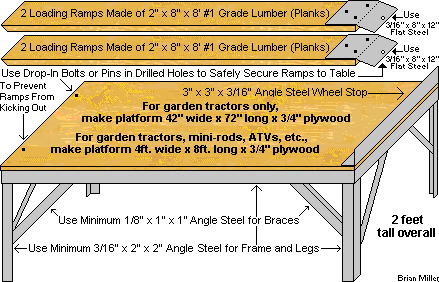 To construct a sturdy platform
table, build it so it will be 2 feet from the floor of minimum 3/16"
x 2" x 2" angle steel for the legs and main frame work, and 1/8" x 1" x 1"
angle steel for bracing of the legs. And for repairing riding mowers, garden
tractors, ATVs, UTVs, etc. with a standard length wheelbase, make the platform
size 42" wide x 72" in length of 3/4"
CCA-treated
plywood to prevent deterioration and rotting if used and/or stored outdoors.
But for competition garden pulling tractors with a longer wheelbase and/or
mini-rods, etc., make the platform
4ft. wide x 8ft. in length of 3/4" CCA-treated plywood. Install a
wheel stop at the front of the table made of sturdy 3"
or 4" tall angled steel to prevent the tractor (or whatever), from rolling
off the table.
To construct a sturdy platform
table, build it so it will be 2 feet from the floor of minimum 3/16"
x 2" x 2" angle steel for the legs and main frame work, and 1/8" x 1" x 1"
angle steel for bracing of the legs. And for repairing riding mowers, garden
tractors, ATVs, UTVs, etc. with a standard length wheelbase, make the platform
size 42" wide x 72" in length of 3/4"
CCA-treated
plywood to prevent deterioration and rotting if used and/or stored outdoors.
But for competition garden pulling tractors with a longer wheelbase and/or
mini-rods, etc., make the platform
4ft. wide x 8ft. in length of 3/4" CCA-treated plywood. Install a
wheel stop at the front of the table made of sturdy 3"
or 4" tall angled steel to prevent the tractor (or whatever), from rolling
off the table.
Use two sturdy loading ramps to load and unload the tractor (or whatever) on and off the table. Make the ramps of 6 x 12 x 8ft. long #1 grade straight-grain lumber (no knots). Use CCA-treated lumber to prevent deterioration and rotting if used and stored outdoors. Fasten a strip of expanded wire mesh on each ramp for traction to prevent tire slippage when driving the vehicle on and off the ramps. (Wet wood can be hazardous to drive on.) Fasten on the end of each ramp, a metal ramp end, made of 3/16" x 8" wide x 12" long flat steel slightly bent to match the level of the table for smooth and unobstructed loading and unloading of a riding mower with a mower deck. For safety purposes, drill two [3/8"] holes in each ramp end and the end of the table to secure the ramps to the table with 3/8" bolts or pins to prevent the ramps from "kicking out" when driving up on the ramps. (The same can be done with the tailgate of a truck.) To "stiffen" the ramps and prevent sagging under a heavy load, fasten an 1/8" x 1-1/2" x 1-1/2" x 7ft. long angle steel under each ramp from excessive bending or possibly breaking when loading and unloading a mini-rod or any heavy [small] vehicle on and off the table. For additional support, place a concrete cinder block or large wooden square block midway of each ramp.
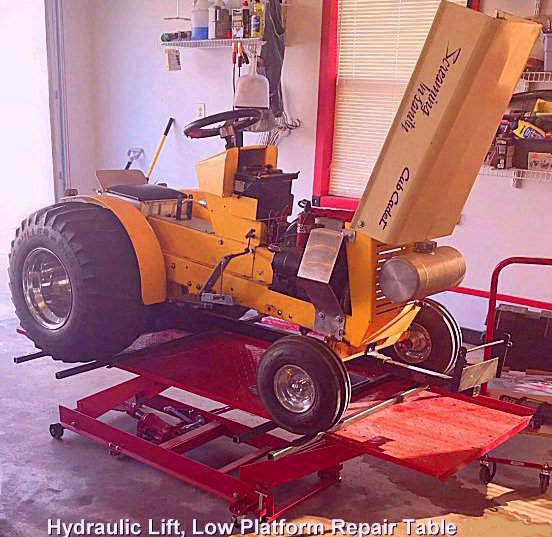
Another high quality all-steel low platform work table that can be used to repair riding mowers, competition garden pulling tractors, etc. is one that's designed for motorcycles is like the one pictured in use in this article. They have a hydraulic lift and a built-in steel loading ramp. With this type of table, a sturdy plywood platform could be mounted on it to make it wider so the tractor will fit better. These are available online and Harbor Freight offers two different motorcycle repair tables, item # 69904 and item # 68892. (Take advantage of Harbor Freight's Money Saving Coupons, Coupon Codes, & Promo Codes, too!)
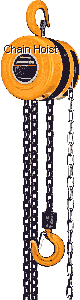

 SAFETY
FIRST!
Use a sturdy and well-supported
overhead beam, or use a well-built
gantry crane with swivel caster wheels with a sturdy chain
wrapped around the beam, and a quality-made
overhead chain hoist to raise the front of a tractor (or
whatever) to safely perform repairs underneath, or raise the rear of the
tractor to remove the rear tire(s) or remove/repair the transaxle, etc. And
to safely and effortlessly remove/lift the [Kohler] engine from the tractor
(with the chain hoist), remove one of the 3/8" cylinder head bolts
midway/centered of the engine (for better balance) and thread a sturdy 3/8"
eye bolt, with the loop welded to the shank, into the head bolt
hole.
SAFETY
FIRST!
Use a sturdy and well-supported
overhead beam, or use a well-built
gantry crane with swivel caster wheels with a sturdy chain
wrapped around the beam, and a quality-made
overhead chain hoist to raise the front of a tractor (or
whatever) to safely perform repairs underneath, or raise the rear of the
tractor to remove the rear tire(s) or remove/repair the transaxle, etc. And
to safely and effortlessly remove/lift the [Kohler] engine from the tractor
(with the chain hoist), remove one of the 3/8" cylinder head bolts
midway/centered of the engine (for better balance) and thread a sturdy 3/8"
eye bolt, with the loop welded to the shank, into the head bolt
hole.
 Unlike the IH and early MTD Cub
Cadets, and most other makes and models of vintage garden tractors, most
so-called garden tractors that's built nowadays won't be in use 30-40 years
from now. They're just not built with true quality nowadays. This is a well-known
and proven fact. The older Cub Cadets and most other makes and models of
vintage garden tractors were built back in the day when most manufacturers
took pride in their products. Nowadays, it's all about American businesses
making more money with Chinese negotiations. If you ever restore an old Cub
Cadet or other make and model of vintage garden tractor, so it's fully
operational, you'd probably fall in love with the heavy duty quality of it.
Because I think any new garden tractor that's build nowadays cannot match
the durability and capabilities of the older Cub Cadets or most other make
and model of vintage garden tractors. Besides, International Harvester builds
big farm tractors and semi-trucks, and they put all that heavy duty technology
into their smaller products. Once you use an older Cub Cadet or other make
and model of vintage garden tractor for whatever purpose, you'd be reluctant
to use anything else. The quality is unmatched to "stamped steel, recycled
junk" that's available nowadays. I think the older Cub Cadets are the "Chevrolet"
Unlike the IH and early MTD Cub
Cadets, and most other makes and models of vintage garden tractors, most
so-called garden tractors that's built nowadays won't be in use 30-40 years
from now. They're just not built with true quality nowadays. This is a well-known
and proven fact. The older Cub Cadets and most other makes and models of
vintage garden tractors were built back in the day when most manufacturers
took pride in their products. Nowadays, it's all about American businesses
making more money with Chinese negotiations. If you ever restore an old Cub
Cadet or other make and model of vintage garden tractor, so it's fully
operational, you'd probably fall in love with the heavy duty quality of it.
Because I think any new garden tractor that's build nowadays cannot match
the durability and capabilities of the older Cub Cadets or most other make
and model of vintage garden tractors. Besides, International Harvester builds
big farm tractors and semi-trucks, and they put all that heavy duty technology
into their smaller products. Once you use an older Cub Cadet or other make
and model of vintage garden tractor for whatever purpose, you'd be reluctant
to use anything else. The quality is unmatched to "stamped steel, recycled
junk" that's available nowadays. I think the older Cub Cadets are the "Chevrolet"
 of garden tractors (you know
what I mean ). When you get to know
how well built the older Cub Cadet garden tractors are, you're never look
at another make and model of older garden tractor the same way. The older
Cub Cadet direct disc clutch drive system garden tractors are a one of a
kind design. There's no other garden tractor like them. All other makes and
models of garden tractors are either belt-driven (or hydrostatically-driven).
Even the manual drive John Deere garden tractors are belt drive. They're
a copycat of manual drive Wheel Horse, Sears Suburban, Massey Ferguson, etc.
Of course, belt-driven (and hydrostatically-driven) garden tractors works
great for general yard and garden work, but not so well for competition pulling.
Anyway, if you do find an older Cub Cadet (or other make and model of vintage
garden tractor), regardless of the condition, just remember that chances
are, unlike virtually everything that's made nowadays, it's well-built, making
it worth repairing, rebuilding and restoring. It'll be like restoring an
older model Chevrolet vehicle (again, you know what I mean
).
of garden tractors (you know
what I mean ). When you get to know
how well built the older Cub Cadet garden tractors are, you're never look
at another make and model of older garden tractor the same way. The older
Cub Cadet direct disc clutch drive system garden tractors are a one of a
kind design. There's no other garden tractor like them. All other makes and
models of garden tractors are either belt-driven (or hydrostatically-driven).
Even the manual drive John Deere garden tractors are belt drive. They're
a copycat of manual drive Wheel Horse, Sears Suburban, Massey Ferguson, etc.
Of course, belt-driven (and hydrostatically-driven) garden tractors works
great for general yard and garden work, but not so well for competition pulling.
Anyway, if you do find an older Cub Cadet (or other make and model of vintage
garden tractor), regardless of the condition, just remember that chances
are, unlike virtually everything that's made nowadays, it's well-built, making
it worth repairing, rebuilding and restoring. It'll be like restoring an
older model Chevrolet vehicle (again, you know what I mean
).
Most older garden tractors are worth restoring because they're built better than anything made nowadays. A lot of old garden tractors have been in service for 40-60 years. Everything made nowadays won't be in service for that long. If they were, the manufacturers would lose money. In the old days, manufacturers gave their customers their money's worth. Nowadays, customers give the manufacturers their money's worth! (Planned obsolescence.)
In my area, central Missouri, the used lawn mower business isn't what it used to be. Since three Walmart Super Centers, Lowes and Home Depot came to town and offer store credit, a lot of people no longer purchase a reconditioned lawn mower or have their old one repaired. They just buy a new lawn mower and make low monthly payments on it.
Identification of IH Cub Cadet Garden Tractor Serial Numbers-to-Date Manufactured, up to 1981 [Top of Page]
| Model of Tractor (Click links for identification of tractor.) | Serial Numbers | Dates Built |
| International Cub Cadet "Original" This model has a K141 [6¼hp] Kohler engine with a starter/generator, internal dry band axle brake, 3/8" wide drive belt-to-pulley/clutch-disc driveshaft and bolted implements. All Cub Cadet Originals have a 16 tooth second gear. (This is the very first Cub Cadet model that IH manufactured from 1960 to 1963. It has no model number; this is why it's referred to as the "Original" Cub Cadet.) | 501 to 65547 | 1960-8/63 |
| 70, 100 These narrow frame models have a K161 (7hp) [70] or K241 (10hp) [100] Kohler engine with a starter/generator; both w/short center section/driveshaft cover; both of these are clutch driven with an internal brake; these tractors with serial # 65458 to 96765 have a 16 tooth 2nd gear; and these tractors with serial # 96766 and above have a 19 tooth second gear. | 65458 to 127160 | 8/63-8/65 |
| 71,
102 These narrow frame models have a K161 (7hp)
[71] or K241 (10hp) [102] Kohler engine with a starter/generator; 71 w/short
center section/driveshaft cover; 102 w/tall center section/driveshaft cover;
both of these are clutch driven with an internal brake; 19 tooth 2nd
gear. 122 This narrow frame model has a 301 (12hp) Kohler engine with a starter/generator; tall center section/driveshaft cover; clutch drive with internal brake; 19 tooth 2nd gear. |
127161 to 218009 | 8/65-11/67 |
| 123 This narrow frame model has a K301 (12hp) Kohler engine with a starter/generator; tall center section/driveshaft cover; hydrostatic drive with an internal brake. | 157490 to 218009 | 6/66-11/67 |
| 72 This narrow frame model has a K161 (7hp) Kohler
engine with a starter/generator; short center section/driveshaft cover; clutch
drive; internal brake; 19 tooth 2nd gear. 104 This narrow frame model has a K241 (10hp) Kohler engine with a starter/generator; tall center section/driveshaft cover; clutch drive; internal brake; 19 tooth 2nd gear. 105 This narrow frame model has a K241 (10hp) Kohler engine with a starter/generator; tall center section/driveshaft cover; hydrostatic drive; internal brake. 124 This narrow frame model has a K301 (12hp) Kohler engine with a starter/generator; tall center section/driveshaft cover; clutch drive; internal brake; 19 tooth 2nd gear. 125 This narrow frame model has a K301 (12hp) Kohler engine with a starter/generator; tall center section/driveshaft cover; hydrostatic drive; internal brake. |
218010 to 306085 | 11/67-08/69 |
| 73 This narrow frame model has a K161 (7hp) Kohler
engine with a starter/generator; short center section/driveshaft cover; clutch
drive; internal brake; 19 tooth 2nd gear. 106 This narrow frame model has a K241 Kohler engine with a starter/generator; tall center section/driveshaft cover; clutch drive; external brakes; 19 tooth 2nd gear. 107 This narrow frame model has a K241 Kohler engine with a starter/generator; tall center section/driveshaft cover; hydrostatic drive; external brakes. 126 This narrow frame model has a K301 Kohler engine with a starter/generator; tall center section/driveshaft cover; clutch drive; external brakes; 19 tooth 2nd gear. 127 This narrow frame model has a K301 Kohler engine with a starter/generator; tall center section/driveshaft cover; hydrostatic drive; external brakes. |
307000 to 400000 | 08/69-08/71 |
| 147 This narrow frame model has a K321 (14hp) Kohler engine with a starter/generator; tall center section/driveshaft cover; hydrostatic drive; external brakes. The frame was widened by factory for an engine with the larger 9½" flywheel and shroud, but never installed. | 316816 to 400000 | 11/69-08/71 |
| 86, 108, 109, 128, 129, 149, 169 These wide frame models have a K181 (8hp) [86], K241 (10hp) [108, 109], K301 (12hp) [128, 129], K321 (14hp) [149] and K341 (16hp) [169] Kohler engine. These have a starter/generator; a solid mounted engine, mechanical PTO clutch. Models 86, 108 and 128 are clutch driven, external brakes w/17 tooth 2nd gear, the others are hydrostatically driven. | 400001 to 529811 | 09/71-10/74 |
| 800 This wide frame tractor is considered a "Quiet Line" model. Has a K181 (8hp) Kohler engine with a gear starter; alternator charging system, clutch drive, ISO-mounted engine; external brakes, electric PTO clutch; 17 tooth 2nd gear. | 5300001 to 572876 | 10/74-1/76 |
| 1100 This wide frame tractor was an economy model of the "Quiet Line" era. V-belt drive with a right angle gearbox and Peerless 2300 series transaxle. It was the first model to use a Briggs & Stratton engine with a Peerless 4-speed transaxle instead of the cast iron IH Cub Cadet transaxle. | Serial numbers unknown |
'74-'79 |
| 1000, 1200, 1250, 1450, 1650 These wide frame tractors are considered "Quiet Line" models. These have a K241 (10hp) [1000], K301 (12hp) [1200, 1250], K321 (14hp) [1450] and K341 (16hp) [1650] Kohler engine. These have ISO-mounted rubber motor mounts to reduce engine vibration throughout the tractor for operator comfort. The engine is enclosed with side panels. It also has a gear starter; alternator charging system, external brakes, electric PTO clutch, an enclosed engine compartment, and it has an oblong shape air cleaner assembly that draws air through the flywheel shroud for less noise. Models 1000 and 1200 are clutch driven w/17 tooth 2nd gear, the others are hydrostatically driven. The "Quiet Line" model tractors with serial # 632502 and later were equipped with 1" diameter front spindles. | 5300001 to 664996 | 10/74-9/79 |
| 482 This spread frame tractor was also an economy "Quiet Line" model. It has an ISO-mounted 11hp Briggs & Stratton horizontal shaft engine; belt drive with a Peerless 2300 series transaxle; red in color. | 665001 to 688742 | 9/79-2/81 |
| 582 This spread frame "Quiet Line" tractor has a
16hp Briggs & Stratton horizontal shaft twin cylinder engine; clutch
drive with an IH transaxle; solid-mounted engine; red in color, external
brakes; 17 tooth 2nd gear. 582 Special This spread frame "Quiet Line" tractor was too, an economy model. It has a 16hp Briggs & Stratton horizontal shaft twin cylinder engine; belt drive with a 2300 series Peerless transaxle; solid-mounted engine; red in color. 682, 782 The 682 has a 19.9hp Onan twin cylinder engine, and the 782 has a KT17 (first design) engine; each are hydrostatic drive; spread frame "Quiet Line" ; solid-mounted engine; red in color, internal brakes. 1282 This particular and rare spread frame "Quiet Line" model has a 16hp Briggs & Stratton horizontal shaft twin cylinder engine; clutch drive with an IH transaxle; solid-mounted engine; red in color, external brakes, with serial number 689126. |
665001 to 700000 | 9/79-4/81 |
| 1282 This more common spread frame "Quiet Line"
model has a K301 (12hp) Kohler engine; hydrostatic drive; ISO-mounted
engine; red in color, internal brake. 982 This spread frame "Quiet Line" model came with either an Onan or Diesel engine; hydrostatic drive; ISO-mounted engine; red in color, external brakes; 7.6" longer wheelbase than previous models. |
665001 to 688712 | 9/79-2/81 |
The IH Cub Cadet production ended and the line was sold to MTD/Cub Cadet
Corporation in June 1981. |
||
The serial number is located in one of the following locations...
NOTE: The model number of the tractor represents horsepower of the engine, and if it's clutch or hydrostatic drive. Odd numbers are hydrostatic (fluid) drive, and even numbers are clutch (mechanical) drive. Example: Model 104 has a K241 (10hp) engine with a clutch drive transaxle, model 105 has a K241 (10hp) engine with a hydrostatically driven transaxle, model 122 has a K301 (12hp) engine with a gear drive transaxle, model 123 has a K301 (12hp) engine with a hydrostatically driven transaxle, etc. The only exceptions are models 71 and 73. They have a K161 (7hp) engine, but they're both gear drive. Why that is, I have no idea.
The "wide" frame models can only accept a single cylinder engine. The "spread" frame models can accept either a single cylinder or a twin cylinder engine because the frame rails were made wider and they lay down more to clear the cylinders of a flathead twin opposed cylinder engine.
FYI - As far as a single cylinder Kohler Magnum engine in a Cub Cadet is concerned, only the single cylinder Kohler K-series engines was installed in IH-built Cub Cadet garden tractors at the factory. No IH-built Cub Cadet garden tractor came from the factory with a single cylinder Magnum engine. When Kohler ended production of their K-series engines, and redesigned them into the Magnum engines in 1979, they wouldn't fit in the narrow or wide frame Cub Cadets. So instead of Cub Cadet redesigning the frame of their tractors to accommodate the single cylinder Magnum engines, they made the spread frame models instead and mainly used the twin cylinder flathead engines in them. Only a few remaining new old stock single cylinder K-series engines was installed in certain spread frame models after 1979. When the stock ran out, Cub Cadet ended production of those models. That's why there wasn't too many of the spread frames made.
MTD/Cub Cadet Corporation Garden/Super Garden Tractor Serial Numbers to Date Manufactured, from 1982 to 1997.
| Model of Tractor All models below have a spread frame, are yellow and white in color and are hydrostatically driven except where specified. The clutch drive models have an MTD aluminum case/housing transaxle. Models w/serial number 719999 and below have internal brakes, and models w/serial number 720000 and up have external caliper brakes. Click links for identification of tractor. |
Serial Numbers (Use last six numbers) |
Year Made |
| 482 (belt drive w/Peerless transaxle), 580 (belt drive w/Peerless transaxle or disc clutch drive w/Cub Cadet transaxle w/17 tooth 2nd gear), 582 (disc clutch drive w/Cub Cadet transaxle w/17 tooth 2nd gear), 582 Special (belt drive w/Peerless transaxle), 680, 682, 782, 782D (Diesel engine), 784, 982 (Onan engine), 984, 986, 1282 | 700000 to 712899 | 1982 |
| 482 (belt drive w/Peerless transaxle), 580 (belt drive w/Peerless transaxle or disc clutch drive w/Cub Cadet transaxle w/17 tooth 2nd gear), 582 (disc clutch drive w/Cub Cadet transaxle w/17 tooth 2nd gear), 582 Special (belt drive w/Peerless transaxle), 680, 682, 782, 782D (Diesel engine), 784, 982 (Onan engine), 984, 986, 1282. Cast-iron case transmission (IH) used from start of production until mid 1983, tractor serial number 719,999. Aluminum-case transmission (MTD) used afterward. | 712900 to 724524 | 1983 |
| 482 (belt drive w/Peerless transaxle), 580 (belt drive w/Peerless transaxle or disc clutch drive w/Cub Cadet transaxle w/17 tooth 2nd gear), 582 (disc clutch drive w/Cub Cadet transaxle w/17 tooth 2nd gear), 582 Special (belt drive w/Peerless transaxle), 680, 682, 782 (KT17 first design engines installed with serial number 726124 and below; KT17 Series II engines installed with serial number 726125 and up), 782D (Diesel engine), 784, 882 (Diesel engine), 982 (Onan engine), 984, 986, 1282 | 724525 to 737624 | 1984 |
| 1210, 1282, 1512, 1604 (belt drive w/Peerless transaxle), 1604 (disc clutch drive w/Cub Cadet transaxle w/17 tooth 2nd gear), 1606 (disc clutch drive w/Cub Cadet transaxle w/17 tooth 2nd gear), 1710, 1711, 1712, 1912, 1914 | 737625 to 747224 | 1985 |
| 1210, 1512, 1604 (belt drive w/Peerless transaxle), 1604 (disc clutch drive w/Cub Cadet transaxle w/17 tooth 2nd gear), 1606 (disc clutch drive w/Cub Cadet transaxle w/17 tooth 2nd gear), 1810, 1811, 1812, 1912, 1914 | 747225 to 756299 | 1986 |
| 1204, 1210, 1211, 1512, 1572, 1806 (disc clutch drive w/Cub Cadet transaxle w/17 tooth 2nd gear), 1810, 1811, 1812, 1872, 2072 | 756300 to 766351 | 1987 |
| 1204, 1210, 1211, 1572, 1806 (disc clutch drive w/Cub Cadet transaxle w/17 tooth 2nd gear), 1810, 1811, 1812, 1872, 2072 | 767352 to 779096 | 1988 |
| 1050 (disc clutch drive w/Cub Cadet transaxle w/17 tooth 2nd gear), 1210, 1211, 1772 (Diesel engine), 1806 (disc clutch drive w/Cub Cadet transaxle w/17 tooth 2nd gear), 1810, 1811, 1812, 1872, 2072 | 779097 to 799999 | 1989 |
| 1340, 1535 (disc clutch drive w/Cub Cadet transaxle w/17 tooth 2nd gear), 1541, 1782, 1860, 1862, 1882, 2082, 2182 | 800000 to 811671 | 1990 |
| 1340, 1535 (disc clutch drive w/Cub Cadet transaxle w/17 tooth 2nd gear), 1541, 1782, 1860, 1862, 1882, 2082, 2182 | 811672 to 821059 | 1991 |
| 1440, 1641, 1782, 1861, 1862, 2082, 2182 | 821101 to 836000 | 1992 |
| 1440, 1641, 1782, 1863, 1864, 2082, 2182 | 836001 to 851000 | 1993 |
| 1440, 1641, 1782, 1863, 1864, 2084, 2182 | 851001 to 864500 | 1994 |
| 1440, 1641, 1782, 1863, 1864, 2182, 2284 | 864501 to 880000 | 1995 |
| 1440, 1641, 1782, 1863, 1864, 2086, 2284 | 880001 to 889000 | 1996 |
| 1440, 1641, 1863, 1864, 2084, 2086, 2284 | 889001 to 899000 | 1997 |
| The above are the last of the "true garden tractors" with the heavy duty, traditional IH-designed frame. See these websites for more information: Cub Cadet Garden Tractor by International Harvester Unofficial Home Page | TractorData.com - Cub Cadet lawn tractors sorted by model. FYI - Most MTD-built spread frame Cub Cadet garden tractors originally came from the factory with a single cylinder flathead engine or the opposed twin cylinder engine. However, certain models came with a Briggs & Stratton Vanguard, Kohler Command, and Kawasaki V-twin engine. | ||
Do V-belt Drive System Garden Tractors Make Competitive Pullers? [Top of Page]
A V-belt will rob an engine of power simply because it "rubs" in the pulleys due to friction, and that's how they grip to transmit power. For an example of how they rob engine power: on a belt drive mower/garden tractor, if the transmission is placed in neutral with the engine running at a slow idle, with the pedal engaged so the belt tightens in the pulleys, the engine will slow down. But with the pedal disengaged so the belt is released/loose in the pulleys, you'll notice how the engine will speed up slightly. Repeat this process several times and you'll really notice the difference. This is why V-belts are no longer used on newer automobiles. Auto manufacturers nowadays use a single serpentine belt to drive all the power accessories, because this type of belt robs the engine of very little power, and it helps to improve fuel mileage. Direct/clutch-drive Cub Cadet garden tractors use no belts whatsoever in the drive train. This means no power is wasted.
However, for competition pulling, sometimes a V-belt drive garden tractor will do very well in the stock class(es), but they tend to lag behind when competing with higher horsepower class tractors, especially Cub Cadets. But if you really like your V-belt garden tractor and want to be a competitive puller in the higher horsepower classes, you can adapt the fenders, hood, grill, etc., from your V-belt garden tractor onto a Cub Cadet chassis/frame and drivetrain. Then you'll have the competition of a Cub Cadet with the looks of your original make and model of garden tractor. Many diehard John Deere garden tractor lovers do this, and compete very well against the Cub Cadets.
If a belt-drive garden tractor is used for competition pulling (that's obviously going to be used in a stock class), the things to keep the drive belt from slipping are:
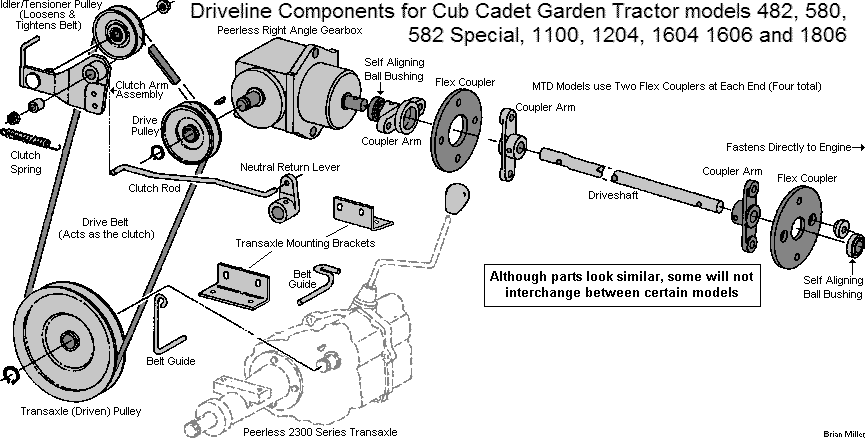
 For competitive pulling, certain
belt-drive transaxles are not geared "just right" to provide the proper ground
speed needed to balance engine power/torque with traction (according to track
conditions). One gear may be slightly too fast and another too slow.
Unfortunately, there are no aftermarket gears available for most belt-drive
transaxles (excluding the Cub Cadet "Original"). So to create an "in-between
speed," to increase the ground speed of a belt-drive tractor, a slightly
larger diameter pulley will need to be installed on the engine and/or a slightly
smaller diameter pulley will need to be installed on the transaxle. To slow
the tractor down or decrease the ground speed, do the opposite. A different
length belt may need to be used. Actually, in the stock class, it's best
to pull with an older garden tractor that have a variable speed drive. The
variable speed drive works much like a manually-operated
belt-drive torque converter. These tractors have a
hand-operated lever that can speed up or slow down the tires when the engine
is over- or under-powered according to load or track conditions. Cub Cadet
pullers that have a problem competing against these type of tractors call
this lever a "cheat stick." FYI
- The built Cub Cadet models 482, 582 Special, 1100, 1204 and 1604 have the
Peerless 2300 series transaxle. This particular transaxle is very tough when
used for general yard and garden work, but one of the axles have been known
to break when pulling competitively with 26-12.00x12 lug tires.
For competitive pulling, certain
belt-drive transaxles are not geared "just right" to provide the proper ground
speed needed to balance engine power/torque with traction (according to track
conditions). One gear may be slightly too fast and another too slow.
Unfortunately, there are no aftermarket gears available for most belt-drive
transaxles (excluding the Cub Cadet "Original"). So to create an "in-between
speed," to increase the ground speed of a belt-drive tractor, a slightly
larger diameter pulley will need to be installed on the engine and/or a slightly
smaller diameter pulley will need to be installed on the transaxle. To slow
the tractor down or decrease the ground speed, do the opposite. A different
length belt may need to be used. Actually, in the stock class, it's best
to pull with an older garden tractor that have a variable speed drive. The
variable speed drive works much like a manually-operated
belt-drive torque converter. These tractors have a
hand-operated lever that can speed up or slow down the tires when the engine
is over- or under-powered according to load or track conditions. Cub Cadet
pullers that have a problem competing against these type of tractors call
this lever a "cheat stick." FYI
- The built Cub Cadet models 482, 582 Special, 1100, 1204 and 1604 have the
Peerless 2300 series transaxle. This particular transaxle is very tough when
used for general yard and garden work, but one of the axles have been known
to break when pulling competitively with 26-12.00x12 lug tires.
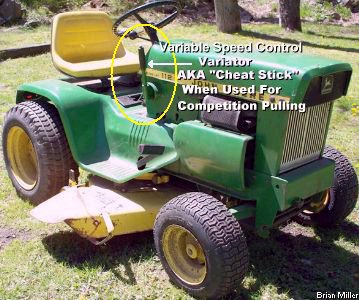 Certain models of John Deere
and Massey Ferguson garden tractors have a variable speed control called
a
"variator," which is a factory-installed lever positioned
on the right of the steering wheel. Most Cub Cadet pullers call this lever
a "cheat stick." When it's pulled back, it slows down the tires to reserve
engine power and torque. When used in competitive pulling, this feature allows
the tractor to have plenty of ground speed upon takeoff and go down the track
with plenty of ground speed, and when the weight of the sled comes up on
the tractor, and if the engine begins to bog down or lose power, the operator
can pull back on the lever, slowing down the tires, so the engine will have
more reserve power to "chug, chug" a little further down the track without
running out of horsepower. It works great in the stock class(es), but being
it's part of a belt-drive drive system, the tractor may lag behind in a higher
horsepower class with a wide open throttle engine.
Certain models of John Deere
and Massey Ferguson garden tractors have a variable speed control called
a
"variator," which is a factory-installed lever positioned
on the right of the steering wheel. Most Cub Cadet pullers call this lever
a "cheat stick." When it's pulled back, it slows down the tires to reserve
engine power and torque. When used in competitive pulling, this feature allows
the tractor to have plenty of ground speed upon takeoff and go down the track
with plenty of ground speed, and when the weight of the sled comes up on
the tractor, and if the engine begins to bog down or lose power, the operator
can pull back on the lever, slowing down the tires, so the engine will have
more reserve power to "chug, chug" a little further down the track without
running out of horsepower. It works great in the stock class(es), but being
it's part of a belt-drive drive system, the tractor may lag behind in a higher
horsepower class with a wide open throttle engine.
How to Prevent a Clutch-Type V-Belt from Flying Off the Pulley(s) at High RPM When Disengaged. To prevent this from happening, use long bolts or fabricate and install two heavy belt guides/retainers so the belt will stay on the pulley(s) when fully disengaged (pressure or tension is released). The guides/retainers can be made from long bolts with jam nuts, or from mild steel, L-shape, 3/16" thick x 1" wide x whatever length they need to be. Then with the tension tight on the belt, fasten the bolts/guides/retainers to the engine block (or tractor frame) close as possible to the drive pulley with the long part of the guide spaced 1/8" from the outside edge of the belt. Position one bolt/guide/retainer over the belt where it goes onto the pulley and the other bolt/guide/retainer under the belt where it comes off the pulley. Secure the guides/retainers in place so they won't rotate. I've done this many times with some of my customer's riding mowers and garden tractors drive and driven pulleys, and mower deck pulleys, and if installed correctly, it works great! Bolts/guides/retainers are not needed for a V-belt that stays tight/engaged all the time. Only for ones that loosens/disengages and tightens up/engages. [Top of Page]
Contact us - [Return To Previous Paragraph, Section or Website]
 To
place an order, please send your item(s) for repairing, and/or for customer
service assistance, and FREE honest and accurate technical support, contact:
A-1 Miller's Performance Enterprises, 12091 N Route B, Hallsville, MO (Missouri)
65255-9604 USA. Please call in your order or send an email with a list parts
you need and your contact information.
To
place an order, please send your item(s) for repairing, and/or for customer
service assistance, and FREE honest and accurate technical support, contact:
A-1 Miller's Performance Enterprises, 12091 N Route B, Hallsville, MO (Missouri)
65255-9604 USA. Please call in your order or send an email with a list parts
you need and your contact information.
 Phone: 1-573-881-7229 (cell;
call, text or leave voicemail). Please call Monday-Friday, 9am to 5pm, Central
time zone, except holidays. If no answer, please try again later. Please
be patient when speaking with me on the phone because I stutter.
Phone: 1-573-881-7229 (cell;
call, text or leave voicemail). Please call Monday-Friday, 9am to 5pm, Central
time zone, except holidays. If no answer, please try again later. Please
be patient when speaking with me on the phone because I stutter.
 E-mail:
pullingtractor@aol.com. A-1 Miller's
shop is open to the public Monday-Friday, 9am to 5pm, Central time zone,
with an appointment on weekends, except holidays. If you're the kind of person
who don't trust delivery/shipping companies (mis)handling your high-dollar
and fragile merchandise, you can make the long drive to A-1 Miller's new
shop (click image to the right) to personally purchase parts, or drop off
and/or pick up your carburetor, clutch assembly, and/or other parts for repairing
and/or rebuilding. Or visit our new shop to drop off your parts. Please contact
us before coming so we'll be at our shop waiting for your arrival. When you
visit our shop, you will be dealing directly with the owner for the best
customer service. "The road to a [trusted] friend's house (or shop) is
never long." Don't sacrifice quality workmanship for distance.
Payment Options below.
Photos
of our new building/shop are posted here!
12091 N Route B, Hallsville, MO - Google Maps.
E-mail:
pullingtractor@aol.com. A-1 Miller's
shop is open to the public Monday-Friday, 9am to 5pm, Central time zone,
with an appointment on weekends, except holidays. If you're the kind of person
who don't trust delivery/shipping companies (mis)handling your high-dollar
and fragile merchandise, you can make the long drive to A-1 Miller's new
shop (click image to the right) to personally purchase parts, or drop off
and/or pick up your carburetor, clutch assembly, and/or other parts for repairing
and/or rebuilding. Or visit our new shop to drop off your parts. Please contact
us before coming so we'll be at our shop waiting for your arrival. When you
visit our shop, you will be dealing directly with the owner for the best
customer service. "The road to a [trusted] friend's house (or shop) is
never long." Don't sacrifice quality workmanship for distance.
Payment Options below.
Photos
of our new building/shop are posted here!
12091 N Route B, Hallsville, MO - Google Maps.
Payment Options, and We Ship to Canada and
Worldwide 
Item(s) in a package or cushioned envelope weighing less than 1 lb. is sent
by US Postal Service Airmail Letter Post for a 4-7 days delivery. Packaged
item(s) weighing over 1 lb. and up to 66 lb. is sent by US Postal Service
Airmail Parcel Post for a 4-10 days delivery. I cannot use the US Postal
Services' Flat Rate Priority Mail envelopes and boxes to ship outside U.S.
territories. Item(s) weighing over 67 lbs. or more is sent by FedEx Ground
or equivalent services. We try to keep our shipping cost to customers within
reason. Therefore, we don't ship our products in a fancy-looking package
with our company name and/or logo on it because most customers will just
toss it in the trash after they remove the contents. And being there is no
USPS tracking number outside the US, all I can do is make sure I write your
address correctly on the customs form and on your package.
My websites are not set up to process orders and accept payments. Therefore, I will need your name, complete and correct postal mailing address and phone number. And for payment options, I accept cash (in person), USPS Postal Money Orders, cashier's checks and business checks. I do not accept credit/debit cards. Or to make a payment to me through PayPal, please click this link: https://www.paypal.com (username: pullingtractor@aol.com). And please use PayPal's "Friends and Family" option to ensure that I receive the full amount or add 3% to the total amount to cover PayPal's processing surcharge. I also accept Venmo (username: Pullingtractor) and Cash App (username: pullingtractor) please add 2% for Cash App's surcharge as well). And be sure to mention a description of what the payment is for with your full name, postal address, phone number and email address. If sending a money order or cashier's check, please include a note in the envelope with your name, complete mailing address, phone number, email address and a description of what the payment is for. I'll make a note of your order when I have all your information, and I may have to order some of the parts on your list, which should take a few days to come in, but I will send everything to you as soon as the parts are in stock after I receive your payment.



Return To Previous Website | Top of Page | Copyright © 1996-Present. This website created, designed and maintained by A-1 Miller's Performance Enterprises